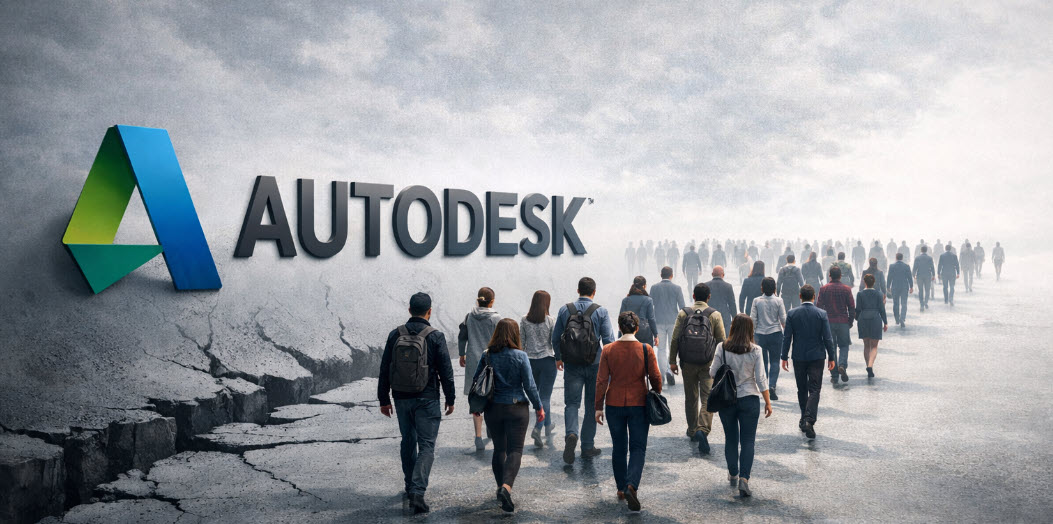
Autodesk has announced another round of layoffs, roughly 7 percent of staff, about a year after the last reduction. Around 1,000 people are affected.
Organizational update to our employees: Our path forward and workforce changes | Autodesk News
https://www.investing.com/news/sec-filings/autodesk-announces-global-restructuring-with-7-workforce-reduction-93CH-4460545
“Autodesk, Inc. (NASDAQ:ADSK) announced Thursday a global restructuring plan that will reduce its workforce by approximately 7%, or about 1,000 employees. The company stated that a significant portion of the layoffs will affect customer-facing sales roles. This move marks the final phase of Autodesk’s sales and marketing optimization efforts.
According to the statement, Autodesk expects to incur pre-tax restructuring charges between $135 million and $160 million, primarily related to employee termination benefits. The company anticipates recording $90 million to $110 million of these charges in the fourth quarter of fiscal year 2026, which ends January 31, 2026, with the remainder expected in fiscal year 2027. Most of these charges will result in cash expenditures during fiscal year 2027. The restructuring plan is expected to be completed by the end of Autodesk’s fourth quarter of fiscal year 2027, subject to local law and consultation requirements.
On paper, this comes during a period of strength. Recent quarters have been solid. In parts of AEC and data, hiring has continued. Investment in areas like Forma and platform data capabilities appears intact. The message from leadership frames this as sales and marketing optimization, with savings reinvested into long term priorities.
And yet, the human impact tells a different story.
This cycle of layoffs followed by hiring creates real instability. Employees I’ve worked with describe living with uncertainty each year from November through March. When strategy shifts this often, growth, then cuts, then growth again, it pushes experienced talent away and makes potential hires think twice. Even those who remain are left wondering what comes next.
After several years of this pattern, it’s understandable that people brace for another round. That expectation alone shapes behavior. It affects morale, risk taking, and trust. Institutional knowledge doesn’t just fade, it walks out the door with every cut.
For customers and partners, this matters too. Many of us rely on continuity in development teams, support, and product direction. Stable teams build better software. They understand edge cases, customer history, and long term intent in ways that are hard to replace quickly.
Cost discipline and focus are real needs. So is adapting to automation and AI driven efficiency. But repeated cycles of disruption carry their own cost, one that doesn’t always show up cleanly on a balance sheet.
I feel for those leaving, and for those staying and some feeling the survivor guilt. Strong quarters are good news. Turning that strength into stability is the harder, and more important, challenge that appears leadership may be failing at.
If anyone needs to connect or advise, access to my network in AEC/MFG Teach, please feel to contact me. I have learned a lot in the past 3 years since my departure in the 2022 Autodesk layoffs.
-Shaan
25 years at Autodesk until 2022 round of Layoffs

Truer words haven’t been written Shaan.