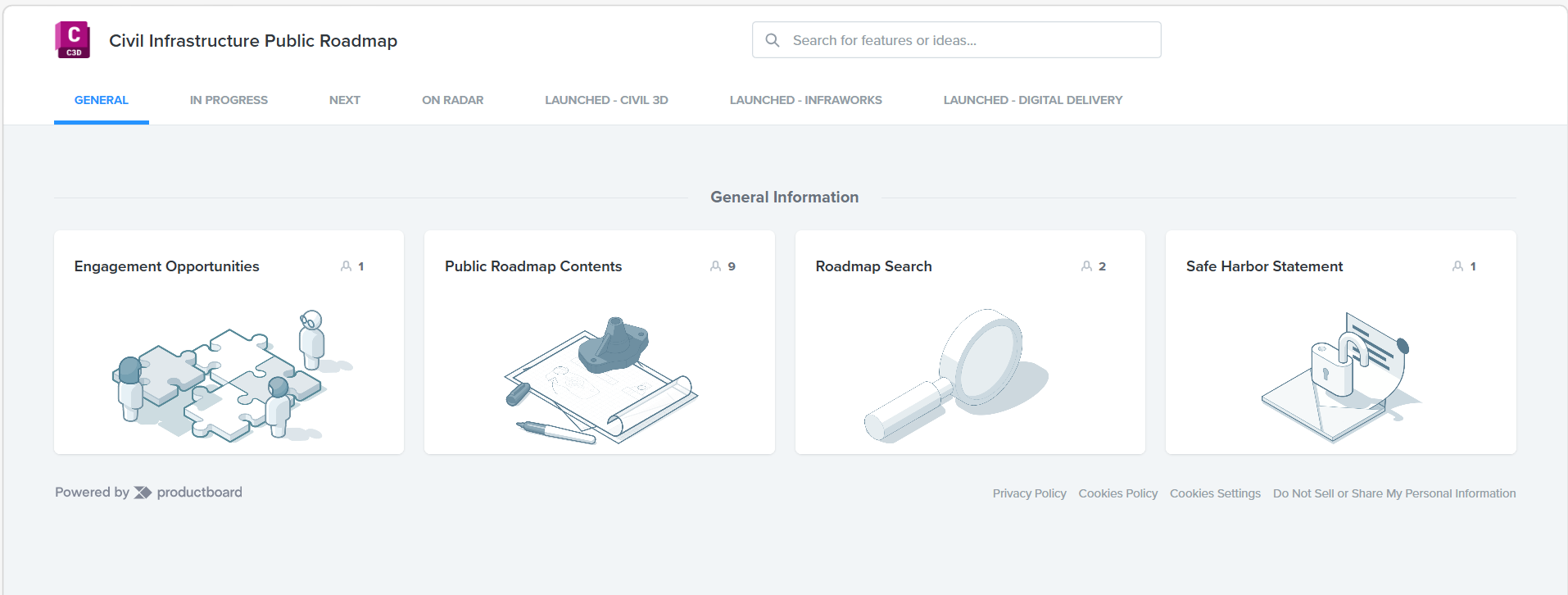
Autodesk recently updated the Civil Infrastructure Public Roadmap after shipping Civil 3D 2027 on April 2, 2026. If you haven’t been on the roadmap lately, it’s worth a visit. A lot has moved and been updated.
What Shipped in Civil 3D 2027

The drainage toolset is the headliner. Underground storage is now fully integrated with styles, naming, and settings. Multi-slope channels are in. Gravity pipe connectivity, labels, and new shapes got work. Pond improvements include porosity and channel connections. Integrated storm simulation runs via InfoDrainage cloud analysis services, with Rainfall Manager and multi-event analysis included.
Horizontal Regression Analysis got a real upgrade. The workflow is modeless now, you can edit alignments directly in the drawing during the regression process using Alignment Editing Tools, and there’s a new machine learning-based detection option for complex survey data. If you do survey-to-alignment work, that last piece is worth testing.
Autodesk Assistant landed as a tech preview. It’s an AI-powered chat interface inside Civil 3D – natural language queries, object styling suggestions, standards checking. Tech preview means it’s experimental and the responses can be wrong, so verify what it tells you. But it’s a real first step, not a demo.
Dynamo updated to Core 4.0.2 with new nodes for Pipes and Catchments. The platform now supports .NET 10. And DWG compatibility is unchanged – binary compatibility runs Civil 3D 2018 through 2027, so no version headaches this cycle.
What’s Currently In Progress

Platform work includes State Plane CS 2022 support (28 votes) and an Autodesk-wide common geolocation solution (35 votes). Both have been persistent asks from firms where coordinate consistency across products is a daily friction point.
On the design side, Streamlined Editing of Vertical Geometry is the most-voted item in this category at 57 votes. Feature Line Performance and Stability is at 36 votes. Secondary Alignment Cant Band support and updated AASHTO and DOT vehicle libraries are also in progress.
Structures has two active items: Advanced Parametric Content in InfraWorks and a new bridge creation and editing experience in Civil 3D.
Drainage continues past the 2027 release. Underground Storage feature and command settings refinements are still being worked, along with Underground Storage Styles. The drainage work from 2027 was clearly not a finish line.
Digital Project Delivery has three active items. Civil Tools in ACC with IFC file format support sits at 39 votes. An inquiry model for engineering details in ACC is at 27 votes. And Civil 3D Content Hosting for pipe catalogs in Autodesk Docs is at 68 votes – the highest-voted item in this section by a wide margin. That last one matters for firms managing large part libraries across projects.
Dynamo work in progress is extensive. The Dynamo MCP Server is in active development at 26 votes. Running Dynamo graphs in the cloud as a service is at 23 votes. Collapsed Group improvements and Connect Dynamo-as-a-service to APS are also in the queue, along with geometry performance improvements, Polysurface improvements, and Intelligent Data Sourcing nodes.
What’s Coming Next

Drawing Cleanup Utility at 77 votes. If you’ve ever inherited a DWG that’s accumulated years of garbage entities and watched it perform accordingly, you know why that one has traction.
But the item that really stands out is Civil 3D to Revit Interoperability at 389 votes. That’s not a typo. Nearly 400 votes on a single roadmap item. It’s the most-voted item visible across the entire Next tab by a factor of five. It reflects something a lot of mixed-discipline firms live with every day.
Other platform items coming next: Civil 3D Object Property Manager performance improvements (27 votes), a Local CS Definition Tool (18 votes), and Shareable Geolocation and Engineering Coordinate support.
Design items in the Next queue include Trimming and Skewing a Corridor (117 votes), Dynamic Offset Feature Lines (101 votes), Offset Normal to Surface (78 votes), and Corridor Section Editor performance improvements. Canadian TAC and DOT vehicle library updates are also in there.
Drainage next up: Culvert Design in Civil 3D (78 votes), Multiple Barrel Pipes (83 votes), and Parametric Gravity Content in Civil 3D (91 votes). Those three represent genuine gaps in what Civil 3D handles natively today, and the vote counts reflect it.
Digital Project Delivery next-up items include Connected Reference on Cloud, Civil Tools in ACC with a separated 2D Profile View (19 votes), a separated 2D Cross Section View (24 votes), and Support Issue Tracking Integration in AutoCAD (43 votes).
How to Submit Your Priorities
Go to the Civil Infrastructure Roadmap page on AEC Tech Drop: autodesk.com/blogs/aec/roadmap/civil-infrastructure-roadmap. The ProductBoard embed is right there. Click any feature card and you get 3 options: Critical, Important, or Nice-to-have. You can also leave a written note with context.
The note matters more than the click. A vote that explains your firm’s specific workflow, project type, or scale gives the product team something to work with. A click alone is a number.
One caveat worth stating clearly: the roadmap is a plan, not a promise. Autodesk is clear that timing and delivery are at their discretion and plans do often change. Don’t use roadmap items to drive purchasing decisions. But DO use the roadmap to make your priorities visible.
Cheers,
Shaan
